
You Waited for Mortgage Rates to Go Down. Now What?
You Waited for Mortgage Rates to Go Down. Now What?
For the past few years, I've had some version of the same conversation with buyers.
"I'm interested, but I'm going to wait until mortgage rates come down."
I understood the reasoning.
Mortgage rates had risen quickly. Monthly payments changed dramatically. For quite a while, economists, financial markets and the media were talking about eventual Federal Reserve rate cuts.
Waiting seemed reasonable. So people waited.
But buying a home has never depended on only one number. While buyers were watching mortgage rates, home prices were changing. Inventory was changing. Seller motivation was changing. Builders were changing their incentives.
And now the interest-rate conversation itself has changed.
The Fed May Raise Rates. What Does That Actually Mean for Mortgage Rates?
As of August 31, financial markets are putting the probability of a Federal Reserve rate increase at the September 15-16 meeting at more than 60%.
That probability increased considerably following comments from Federal Reserve Chair Kevin Warsh about persistent inflation and the possibility that additional action could be necessary.
But there is an important distinction here.
The Federal Reserve does not set your 30-year mortgage rate.
The Fed controls a short-term benchmark interest rate.
Thirty-year mortgage rates are influenced much more directly by longer-term Treasury yields, mortgage-backed securities, inflation expectations, economic growth and what financial markets believe the Fed will do in the future.
That is why mortgage rates frequently move before the Federal Reserve actually does anything.Markets don't wait for the announcement. They try to anticipate it.
Freddie Mac's latest national survey, released August 27, puts the average 30-year fixed mortgage at 6.66%, almost unchanged from the previous week's 6.65%.
So, if the Fed raises its rate by one-quarter percentage point in September, that does not mean your mortgage rate automatically rises by one-quarter point the next morning. Some of those expectations may already be priced into the market. The bigger concern for mortgage rates would be persistent inflation and financial markets concluding that more increases are coming after September.
But There's Another Number Buyers Have Been Waiting On
Interest rates were only half of the bet. Many buyers weren't simply waiting for lower mortgage rates. They were also expecting home prices to decline. That is where the last few years have become interesting.
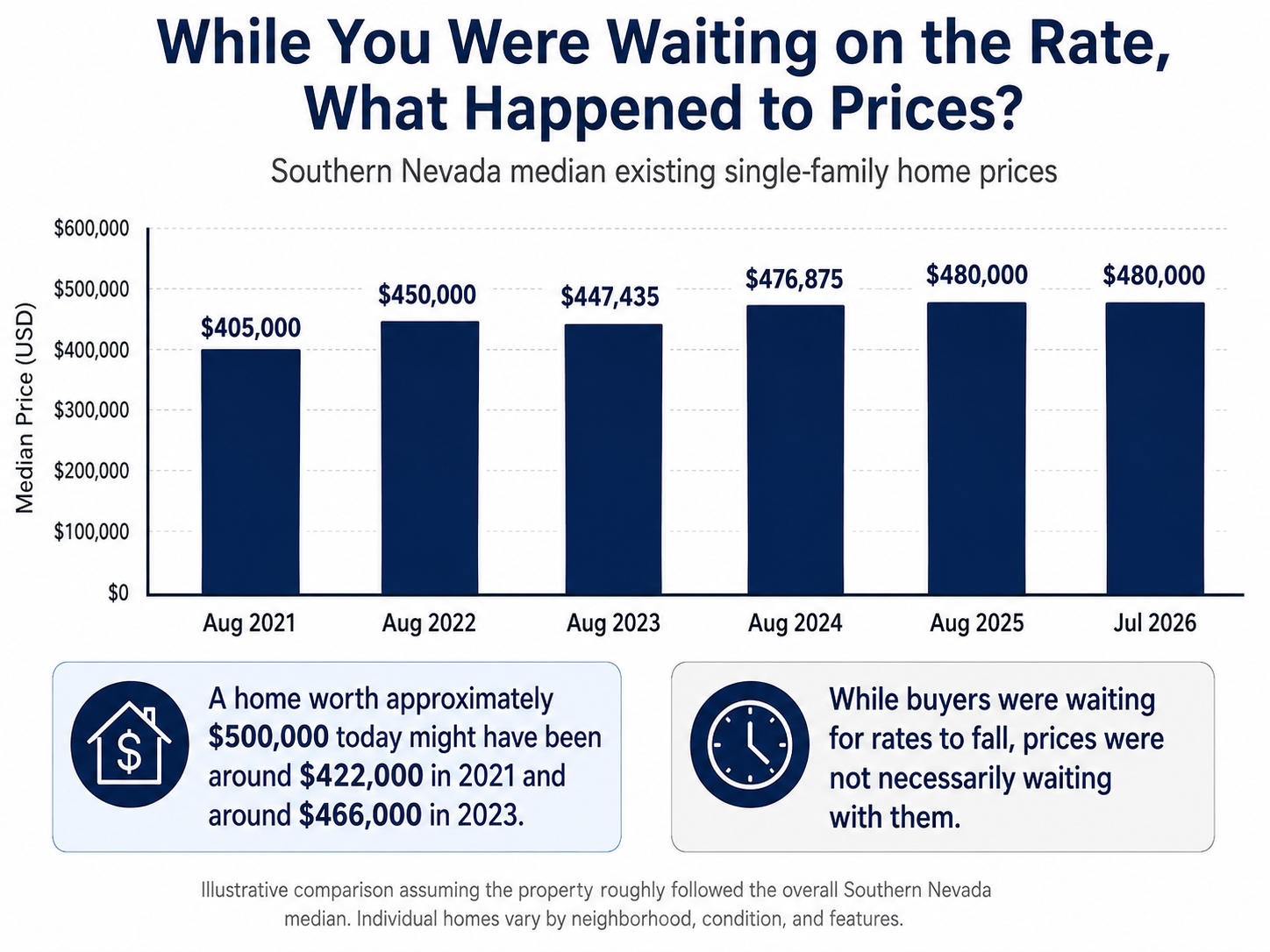
Southern Nevada's median price for an existing single-family home was approximately:
August 2021: $405,000
August 2022: $450,000
August 2023: $447,435
August 2024: $476,875
August 2025: $480,000
July 2026: $480,000
The important thing about those numbers is that they don't tell the simplistic story that "real estate always goes up." It doesn't.
Prices climbed rapidly, declined somewhat, flattened and then increased again. But something many waiting buyers expected did not happen.
We didn't get a broad combination of dramatically lower mortgage rates and dramatically lower home prices.That combination has remained elusive.
What Would a $500,000 Home Today Have Looked Like a Few Years Ago?
Here is another way of looking at it.
If a property worth approximately $500,000 today had moved exactly in line with the overall Southern Nevada median, its approximate market-equivalent price would have been:
2021: $422,000
2022: $469,000
2023: $466,000
2024: $497,000
2025: $500,000
Today: $500,000
That is an illustration, not an appraisal. Individual homes don't appreciate exactly with the median. Neighborhood, condition, age, lot, upgrades, property type and buyer demand all matter.
But it makes the larger point:While you were waiting on the interest rate, the other numbers didn't stand still.
If you started waiting in 2023, the market-equivalent difference on that example is approximately $34,000 in purchase price. If you started waiting in 2021, the difference is closer to $78,000.
That doesn't automatically mean you made a mistake by waiting.
It means we should stop evaluating that decision using only the mortgage rate.
Now Let's Look at the Payment
This is where the mortgage-rate discussion becomes real. Using a $500,000, 30-year mortgage as a simple example:
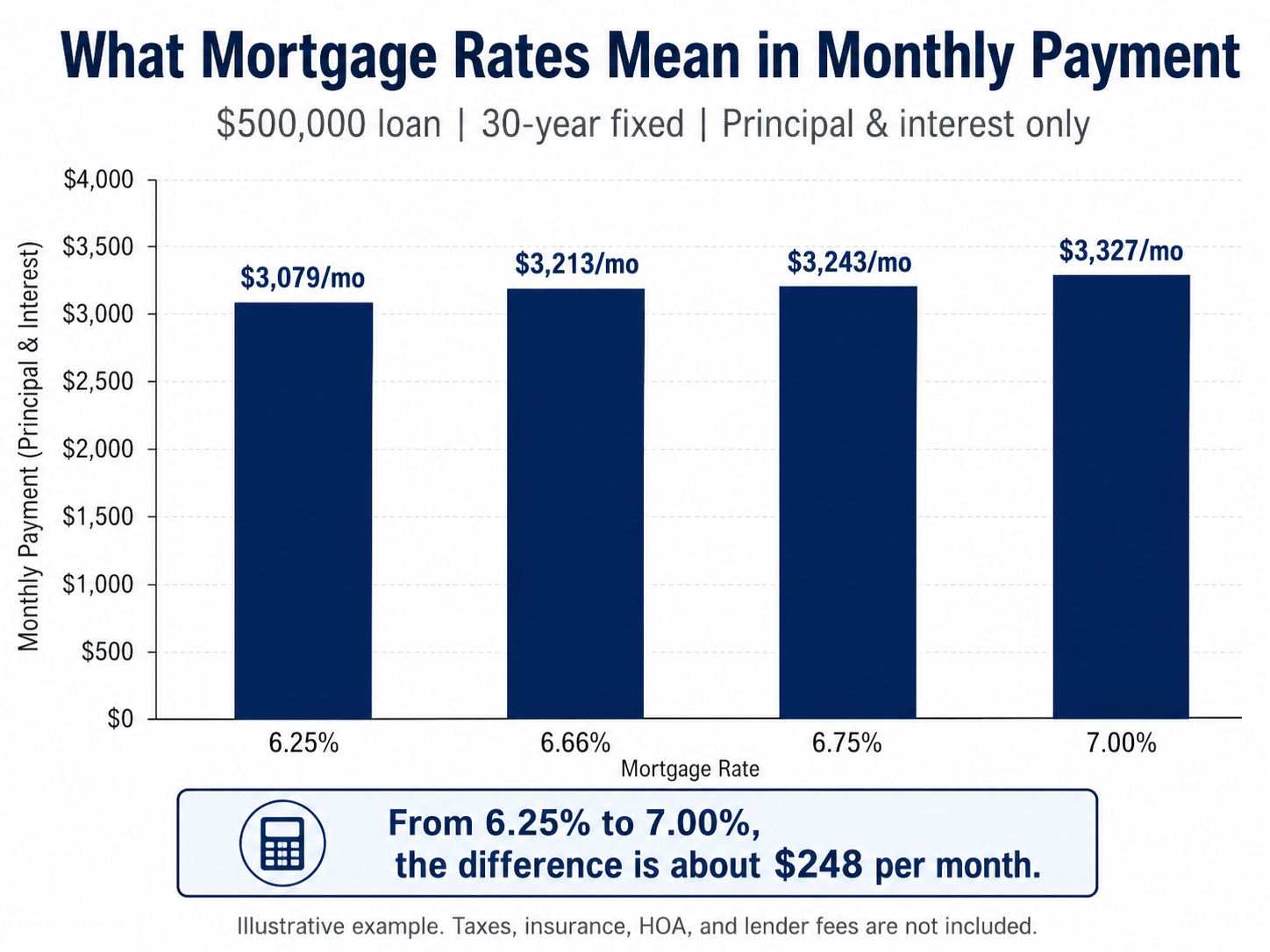
At 6.25%, principal and interest are approximately $3,079 per month.
At 6.66%, approximately $3,213.
At 6.75%, approximately $3,243.
At 7.00%, approximately $3,327.
These examples do not include property taxes, homeowners’ insurance, HOA costs, mortgage insurance where applicable or lender fees.
Going from 6.25% to 7.00% increases principal and interest by approximately $248 per month. That's real money. I'm not going to pretend otherwise.
But there is another question I think buyers should ask.
What Can You Negotiate Today That You Couldn't Negotiate Before?
This is the part that often gets left out of the interest-rate discussion. Mortgage rates are higher than buyers would like. But today's housing market also gives buyers something they had very little of during the frenzy several years ago:
Leverage.
Depending on the property and seller, that can mean: A lower negotiated purchase price. Seller-paid closing costs. A seller contribution toward a mortgage-rate buydown. Repairs that a seller might previously have refused. A builder incentive on New Construction with Preferred-lender financing. Closing-cost assistance. Sometimes a combination of several of these.
The lowest interest rate does not necessarily create the best transaction. Likewise, the lowest purchase price doesn't necessarily create the best transaction. What matters is the complete financial package.
A Seller Credit Can Sometimes Be More Valuable Than Another Small Price Reduction
Here's a simple example.
Suppose you're buying with a $500,000 mortgage at a 6.75% permanent interest rate. Principal and interest would be about $3,243 per month. Now suppose we negotiate a seller contribution that your lender can use to fund a temporary 2-1 mortgage-rate buydown.
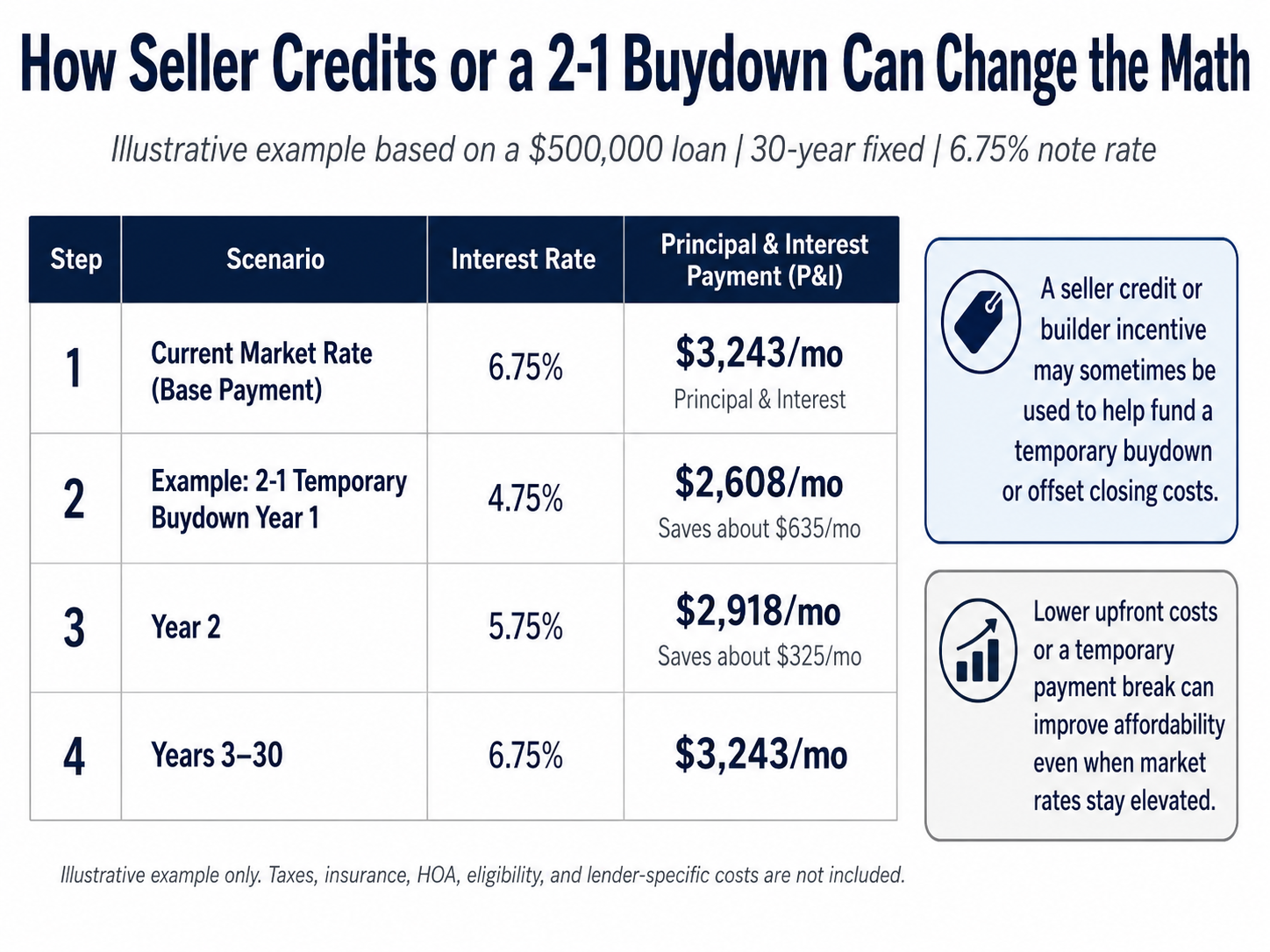
In the first year, your effective payment rate could be 4.75%. The principal-and-interest payment would be approximately $2,608 per month. That's about $635 less per month during the first year.
In year two, the effective rate would be 5.75%. The payment would be approximately $2,918, about $325 less per month than the permanent payment. Beginning in year three, the payment returns to the amount based on the permanent 6.75% note rate.
A temporary buydown doesn't change the permanent mortgage rate, and it is not appropriate for every buyer. The borrower must qualify under lender guidelines, and the cost and structure need to be calculated by the lender. But it illustrates why negotiation matters.
The question shouldn't always be:
"Can I get another $10,000 off the purchase price?" Sometimes the better question is: "What's the most valuable way to use that $10,000?" That's where having the Realtor and lender working together on the strategy becomes important.
New Construction Makes This Even More Interesting
Builders have an affordability problem too. They need to sell homes. And many builders would rather protect the recorded sale price of their homes than simply reduce prices substantially.
That is one reason preferred-lender incentives can sometimes be aggressive. A builder may offer closing-cost assistance, financing incentives or subsidized mortgage rates that a normal resale seller simply cannot duplicate. That does not automatically mean new construction is the better deal.
You still have to account for upgrades, lot premiums, landscaping, window coverings, appliances, HOA fees, SID/LID assessments where applicable and the property's eventual resale position.
But it is absolutely part of the comparison.
I increasingly look at new construction and resale as competing financial packages, not simply competing house prices.
What Happens If Mortgage Rates Finally Drop?
Here's the other side of waiting that deserves consideration. Suppose mortgage rates suddenly fall substantially.
That's good news.
But you'll probably notice something. So will everyone else. Buyers who have been sitting on the sidelines may return. More buyers can mean more competition. More competition can mean sellers are less willing to negotiate. And that can mean fewer seller credits, fewer price reductions and fewer concessions. There is no guarantee that will happen. But it is part of the risk of waiting for the "perfect rate." You could get a lower mortgage rate later and simultaneously lose some of the negotiating leverage available today.
That is why I don't believe the decision should ever be based on one number.
So, After Waiting for Rates to Come Down, What Should You Do Now?
First, don't panic.
A potential Fed increase is not a reason to rush out and buy a house. I also wouldn't buy because someone tells you rates are "definitely going higher."
Nobody knows that.
But I wouldn't continue waiting automatically because someone tells you rates will eventually return to 5% either. Nobody knows that, either. Instead, I would rerun the numbers. A lot has changed since you originally decided to wait. Mortgage rates changed. Home prices changed. Inventory changed. Seller motivation changed. Builder incentives changed. Your income and finances may have changed too.
So let's answer the question based on the market we actually have today.
What homes can you comfortably afford? What would your actual payment be? How much cash would you need? Which sellers are negotiable? What concessions could reasonably be requested? Are any builders offering financing worth considering? Would a temporary or permanent rate buydown make sense?
And most importantly:
Is there a home you actually want to own at numbers that work for your life?
If the answer is no, don't buy it.Waiting may still be the correct decision.
But if the answer is yes, waiting indefinitely for a mortgage rate that may or may not arrive deserves another look.
Let's Look at Your Numbers, Not the Headlines
If mortgage rates have been the primary reason you've stayed on the sidelines, I'm happy to sit down with you and look at the complete strategy.
We can compare resale homes, new construction, current pricing, negotiating opportunities and the concessions that may realistically be available. And if you haven't spoken with a lender recently, I can introduce you to one of my preferred lenders for a no-pressure evaluation of your circumstances.
They can calculate your actual buying power, estimated payment, cash requirements and different financing structures. You may look at everything and decide now isn't the right time. That's perfectly fine. You may also discover that the market offers an opportunity today that you didn't realize was there.
Either way, I'd rather see you make the decision based on your numbers than on another prediction about where mortgage rates might be six months from now.
Roger Price Owens, LLC
Realtor®
Real Broker, LLC
702-985-6625
roger@roger.realtor
www.listingsoflasvegas.com
S.0179116.LLC
Mortgage examples are illustrative only and are not loan quotes. Rates, programs and qualifications vary by lender and borrower.
Southern Nevada housing figures cited are market medians and do not represent the value or appreciation of an individual property.
Categories
Recent Posts