
Data Centers Near Las Vegas Homes: What Buyers Should Know in 2026
Data Centers Are Moving Closer to Homes: What Las Vegas and Henderson Buyers Should Know
![Data Centers Are Moving Closer to Homes: What Las Vegas and Henderson Buyers Should Know SEO Title: Data Centers Near Las Vegas Homes: What Buyers Should Know in 2026 Suggested URL Slug: /blog/data-centers-las-vegas-henderson-homebuyers Meta Description: Data centers are expanding across the Las Vegas Valley. Here is what Henderson and Las Vegas buyers should know about housing, power, water, zoning, resale, and nearby development. [Insert Hero Image Here] Image: Switch data center campus photo Caption: A data center campus in Southern Nevada. As AI and cloud infrastructure expand, buyers are asking what these projects mean for housing, power, water, and resale. Alt text: Switch data center campus in Southern Nevada with red and white industrial buildings under a blue sky. Data centers were not on most buyers’ radar a few years ago. Now they are. As artificial intelligence, cloud computing, and digital infrastructure continue to expand, large data centers are showing up in more American communities, including parts of the Las Vegas Valley. That has created a practical real estate question for buyers and homeowners: What does it mean if a large data center is built near the home I own or may buy? The answer is more nuanced than the headlines. The short version is this: current national housing research does not show a clear drop in home values simply because a large data center opened nearby. But that does not mean the issue should be ignored. For Las Vegas and Henderson buyers, the more important questions involve electricity demand, water use, industrial zoning, noise, future land use, and whether one approved project can lead to several more. Are more homes being sold near data centers? Yes. National Realtor.com research shows that the share of U.S. home sales taking place within five miles of a large data center has more than doubled since 2018. That does not mean buyers are suddenly seeking out homes near data centers. It means data centers are being built in more communities and closer to where people already live. [Insert Image Here] Image: More Americans Buy Homes Near Large Data Centers chart Caption: Realtor.com research shows the share of U.S. home sales within five miles of a large data center has risen to 1.5%, with the development pipeline pushing that figure higher. Alt text: Chart showing the share of U.S. home sales near large data centers rising from 2018 through 2027. This is one reason the subject matters to buyers in Southern Nevada. The question is no longer limited to major tech hubs. Data-center growth is moving outward into less dense, more suburban, and more rural areas. In places like Las Vegas and Henderson, where development patterns can change quickly, that means buyers need to think beyond the home itself and consider what surrounding land may become. Do data centers lower home values? So far, the evidence does not show a measurable decline in home prices simply because a large data center opened nearby. That is worth saying clearly, because this is where some of the alarmist talk falls apart. Realtor.com compared ZIP codes that received large data centers with similar ZIP codes that did not. Over the first two years after a facility opened, there was no statistically meaningful difference in home-price performance. Nearby homes did not clearly outperform, but they also did not clearly underperform. That is the good news. The caution is that the research window is still relatively short. Some effects may take longer to show up. Buyers may react differently over time to issues such as noise, electrical infrastructure, truck traffic, cooling systems, or the simple reality of living near a permanently industrial use. So if you are looking for a straight answer, here it is: No, the current research does not support saying that data centers automatically hurt nearby home values. But that is not the same as saying they never matter. Data centers are moving into lower-income and less established areas This is one of the more important shifts in the national data. New data centers are increasingly being built in lower-income communities and in areas with less housing density. That matters because lower-density communities often have less experience dealing with large industrial neighbors, thinner tax bases, and fewer resources to respond to land-use and infrastructure concerns. [Insert Image Here] Image: Data Centers Expanding in Low-Income Areas chart Caption: New large data centers are increasingly being built in lower-income communities, a shift that raises additional land-use and community-impact questions. Alt text: Bar chart showing that new data centers are increasingly opening in ZIP codes with household incomes at or below the national median. For Southern Nevada, that shift is relevant because many future development areas still appear wide open today. Buyers may look at vacant land and assume they know what is coming. Sometimes they do not. Vacant land is not neutral. It has a zoning story, a planning story, and often a utility story behind it. Will a nearby data center lower my property taxes? Probably not in any automatic or meaningful way. A lot of homeowners assume that if a huge commercial facility arrives nearby, their tax bill should benefit. The research does not support making that promise. Communities near data centers sometimes showed lower effective property-tax rates, but those differences largely existed before the facilities arrived. In other words, there is no clear evidence that a new data center opening nearby translates into lower residential property taxes. [Insert Image Here] Image: Property-tax comparison chart Caption: Realtor.com found no clear evidence that homeowners automatically benefit through lower property-tax rates when a large data center opens nearby. Alt text: Line chart comparing effective residential property-tax rates near large data centers versus control areas over time. Tax revenue may help a jurisdiction. It may fund infrastructure or local priorities. But homeowners should not assume a large data center is going to lower their own tax bill. That outcome depends on local government decisions, budgeting, and how the property is actually assessed. There is another housing angle people are missing: labor and construction Data centers do not just affect land use. They can affect the broader housing market too. Large data-center projects need electricians, HVAC specialists, utility crews, and other skilled trades. Those are many of the same people residential builders rely on. In the short term, that can tighten labor availability and put pressure on construction costs and timelines for housing. In the long run, there is a possible upside. Higher wages and strong demand may pull more workers into the trades and expand the talent pipeline. But in the meantime, large infrastructure projects can compete with the housing industry for scarce labor. This matters in the Las Vegas Valley because growth here is not theoretical. We are still building communities, expanding employment centers, and trying to balance affordability with rising development costs. Why is this especially relevant in Las Vegas and Henderson? Because Southern Nevada is not just watching the national data-center story from a distance. We are part of it. The Las Vegas Valley already has established data-center operations and continued interest in expansion. At the same time, local governments and utilities are studying how these projects affect power demand, land use, infrastructure planning, and neighborhood compatibility. That is the real local angle. This is not just a story about “technology.” It is a story about what kind of development is being approved, where it is being approved, and what else may follow once the infrastructure is in place. What about water use in Southern Nevada? Water is the first concern many people raise, and for obvious reasons. But the Las Vegas discussion needs more nuance than the national version. Southern Nevada has already moved to limit certain water-intensive cooling practices in new commercial and industrial development. That means buyers should not treat every data center as if it uses the same cooling system or the same amount of water. The better question is: What cooling technology is being used, and what does that mean locally? That is a much more intelligent question than simply assuming every data center has the same footprint. Electricity may be the bigger long-term issue If I had to pick the issue most likely to matter over time in Southern Nevada, it would be power. Large data centers are major electricity users. That raises questions about substations, transmission lines, utility infrastructure, and who ultimately pays for the capacity needed to support growth. NV Energy and state regulators are already studying those issues because the scale of potential demand is significant. That does not mean a buyer should panic about utility bills. It does mean that a serious buyer, especially one purchasing near industrial or future employment land, should understand that data centers are as much a utility-infrastructure story as they are a real estate story. [Insert Image Here] Image: Local data center rendering Caption: Renderings and proposed projects matter because the real estate question is not just what exists today, but what may be approved around a property tomorrow. Alt text: Rendering of a large industrial data center building in a desert setting with mountains in the background. Why buyers should care about what could come next One approved data center does not always stay one data center. Once land is entitled, utilities are planned, and supporting infrastructure is in place, other similar projects can become easier to approve nearby. That is one reason some markets end up with clusters rather than isolated facilities. For a homebuyer, that changes the due-diligence conversation. The right question is not only: Is there a data center near this home today? It is also: What has been approved, what is proposed, what does the zoning allow, and what could this area look like five years from now? That is where real estate advice becomes useful. What should a Las Vegas or Henderson buyer investigate? If I were helping a buyer evaluate a property near future development land, I would want answers to these questions: What is the current zoning on nearby land? Are there pending applications for industrial, utility, or infrastructure uses? Is there planned power infrastructure such as substations or transmission improvements nearby? What kind of cooling and building systems are proposed? Will there be generator noise, lighting, truck traffic, or other operational impacts? Is this likely to remain a single project, or could it become a larger cluster? How will the surrounding area feel to a future buyer at resale? This is why I always tell clients that a listing only tells part of the story. A listing tells you about the house. Due diligence tells you what you’re buying around it. Final thoughts Data centers are not automatically bad for housing. They are also not something buyers should casually dismiss. The best available research offers some reassurance. Home values near large data centers have generally moved in line with comparable neighborhoods, at least in the early years studied. But the next wave of development is larger, more power-intensive, and moving into new kinds of communities. For Las Vegas and Henderson buyers, the smarter approach is not fear. It is clarity. If you are considering a home near major future development land, industrial zoning, or expanding infrastructure, the question is not just whether the home works for you today. It is whether the surrounding environment will still make sense for your lifestyle and resale plans later. That is the work that matters. Frequently Asked Questions Do data centers lower nearby home values? Not based on the best current research. So far, home prices near newly opened large data centers have generally moved in line with comparable neighborhoods without them. Are data centers expanding in Las Vegas and Henderson? Yes. Southern Nevada is part of the broader expansion story, which is why local governments, utilities, and buyers are paying closer attention to where these projects are located and how they are evaluated. Should homeowners expect lower property taxes near a data center? No. There is no clear evidence that a new data center automatically lowers nearby homeowners’ property-tax bills. Why are data centers controversial? The biggest concerns usually involve electricity demand, water use, cooling systems, noise, traffic, infrastructure strain, and the long-term effect of industrial development near homes. What should buyers ask before purchasing near one? Ask about zoning, pending development applications, utility infrastructure, cooling systems, noise, visibility, traffic, and the long-term development pattern of the area. Need help evaluating the area around a home? If you are buying in Henderson or the Las Vegas Valley, I can help you look past the listing photos and evaluate the surrounding land use, future development, and resale implications before you commit.](https://cdn.lofty.com/image/fs/415669302001877/website/26633/cmsbuild/2026816_2d455c82127f4f22.jpeg)
Caption: A data center campus in Southern Nevada. As AI and cloud infrastructure expand, buyers are asking what these projects mean for housing, power, water, and resale.
Data centers were not on most buyers’ radar a few years ago.
Now they are.
As artificial intelligence, cloud computing, and digital infrastructure continue to expand, large data centers are showing up in more American communities, including parts of the Las Vegas Valley. That has created a practical real estate question for buyers and homeowners:
What does it mean if a large data center is built near the home I own or may buy?
The answer is more nuanced than the headlines.
The short version is this: current national housing research does not show a clear drop in home values simply because a large data center opened nearby. But that does not mean the issue should be ignored. For Las Vegas and Henderson buyers, the more important questions involve electricity demand, water use, industrial zoning, noise, future land use, and whether one approved project can lead to several more.
Are more homes being sold near data centers?
Yes.
National Realtor.com research shows that the share of U.S. home sales taking place within five miles of a large data center has more than doubled since 2018. That does not mean buyers are suddenly seeking out homes near data centers. It means data centers are being built in more communities and closer to where people already live.
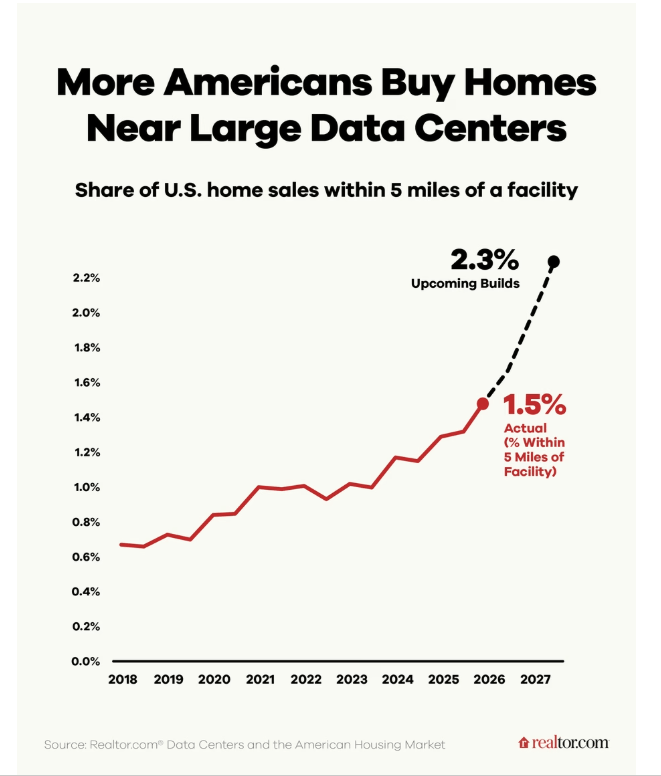
Caption: Realtor.com research shows the share of U.S. home sales within five miles of a large data center has risen to 1.5%, with the development pipeline pushing that figure higher.
This is one reason the subject matters to buyers in Southern Nevada.
The question is no longer limited to major tech hubs. Data-center growth is moving outward into less dense, more suburban, and more rural areas. In places like Las Vegas and Henderson, where development patterns can change quickly, that means buyers need to think beyond the home itself and consider what surrounding land may become.
Do data centers lower home values?
So far, the evidence does not show a measurable decline in home prices simply because a large data center opened nearby.
That is worth saying clearly, because this is where some of the alarmist talk falls apart.
Realtor.com compared ZIP codes that received large data centers with similar ZIP codes that did not. Over the first two years after a facility opened, there was no statistically meaningful difference in home-price performance. Nearby homes did not clearly outperform, but they also did not clearly underperform.
That is the good news.
The caution is that the research window is still relatively short. Some effects may take longer to show up. Buyers may react differently over time to issues such as noise, electrical infrastructure, truck traffic, cooling systems, or the simple reality of living near a permanently industrial use.
So if you are looking for a straight answer, here it is:
No, the current research does not support saying that data centers automatically hurt nearby home values. But that is not the same as saying they never matter.
Data centers are moving into lower-income and less established areas
This is one of the more important shifts in the national data.
New data centers are increasingly being built in lower-income communities and in areas with less housing density. That matters because lower-density communities often have less experience dealing with large industrial neighbors, thinner tax bases, and fewer resources to respond to land-use and infrastructure concerns.
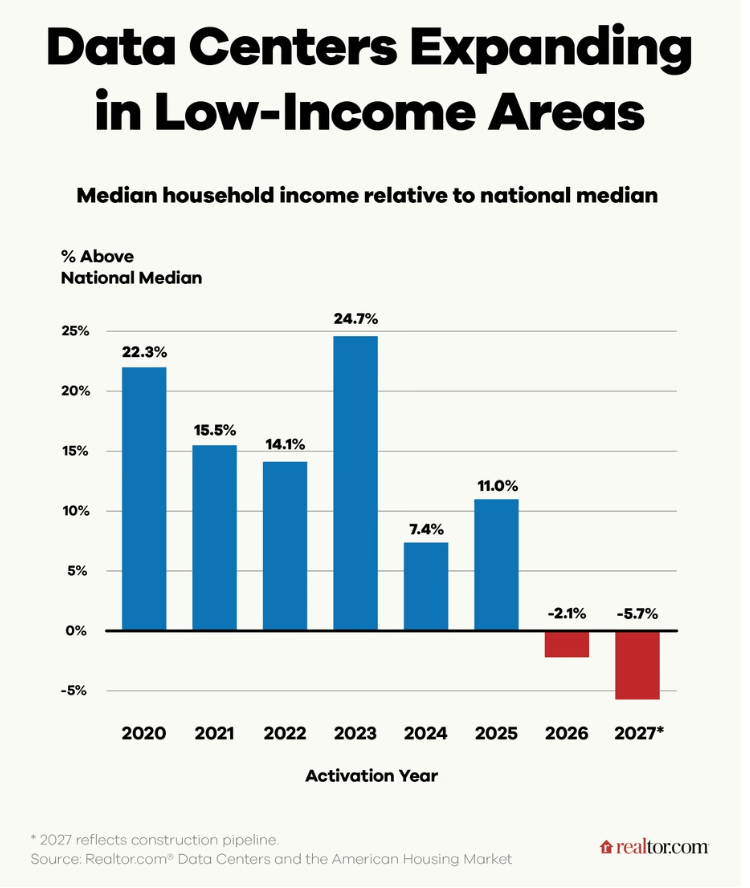
Caption: New large data centers are increasingly being built in lower-income communities, a shift that raises additional land-use and community-impact questions.
For Southern Nevada, that shift is relevant because many future development areas still appear wide open today. Buyers may look at vacant land and assume they know what is coming. Sometimes they do not.
Vacant land is not neutral. It has a zoning story, a planning story, and often a utility story behind it.
Will a nearby data center lower my property taxes?
Probably not in any automatic or meaningful way.
A lot of homeowners assume that if a huge commercial facility arrives nearby, their tax bill should benefit. The research does not support making that promise. Communities near data centers sometimes showed lower effective property-tax rates, but those differences largely existed before the facilities arrived. In other words, there is no clear evidence that a new data center opening nearby translates into lower residential property taxes.
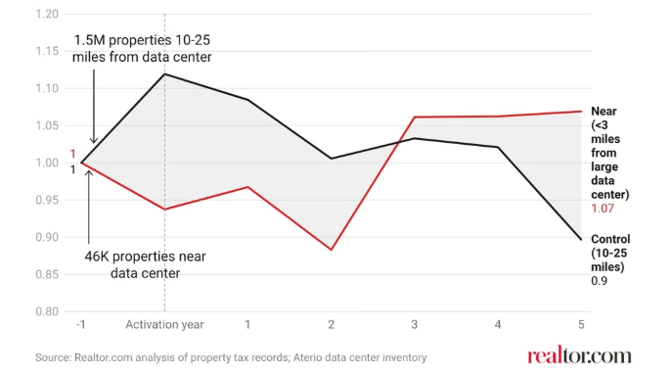
Caption: Realtor.com found no clear evidence that homeowners automatically benefit through lower property-tax rates when a large data center opens nearby.
Tax revenue may help a jurisdiction. It may fund infrastructure or local priorities. But homeowners should not assume a large data center is going to lower their own tax bill. That outcome depends on local government decisions, budgeting, and how the property is actually assessed.
There is another housing angle people are missing: labor and construction
Data centers do not just affect land use. They can affect the broader housing market too.
Large data-center projects need electricians, HVAC specialists, utility crews, and other skilled trades. Those are many of the same people residential builders rely on. In the short term, that can tighten labor availability and put pressure on construction costs and timelines for housing.
In the long run, there is a possible upside. Higher wages and strong demand may pull more workers into the trades and expand the talent pipeline. But in the meantime, large infrastructure projects can compete with the housing industry for scarce labor.
This matters in the Las Vegas Valley because growth here is not theoretical. We are still building communities, expanding employment centers, and trying to balance affordability with rising development costs.
Why is this especially relevant in Las Vegas and Henderson?
Because Southern Nevada is not just watching the national data-center story from a distance. We are part of it.
The Las Vegas Valley already has established data-center operations and continued interest in expansion. At the same time, local governments and utilities are studying how these projects affect power demand, land use, infrastructure planning, and neighborhood compatibility.
That is the real local angle.
This is not just a story about “technology.” It is a story about what kind of development is being approved, where it is being approved, and what else may follow once the infrastructure is in place.
What about water use in Southern Nevada?
Water is the first concern many people raise, and for obvious reasons.
But the Las Vegas discussion needs more nuance than the national version. Southern Nevada has already moved to limit certain water-intensive cooling practices in new commercial and industrial development. That means buyers should not treat every data center as if it uses the same cooling system or the same amount of water.
The better question is:
What cooling technology is being used, and what does that mean locally?
That is a much more intelligent question than simply assuming every data center has the same footprint.
Electricity may be the bigger long-term issue
If I had to pick the issue most likely to matter over time in Southern Nevada, it would be power.
Large data centers are major electricity users. That raises questions about substations, transmission lines, utility infrastructure, and who ultimately pays for the capacity needed to support growth. NV Energy and state regulators are already studying those issues because the scale of potential demand is significant.
That does not mean a buyer should panic about utility bills.
It does mean that a serious buyer, especially one purchasing near industrial or future employment land, should understand that data centers are as much a utility-infrastructure story as they are a real estate story.
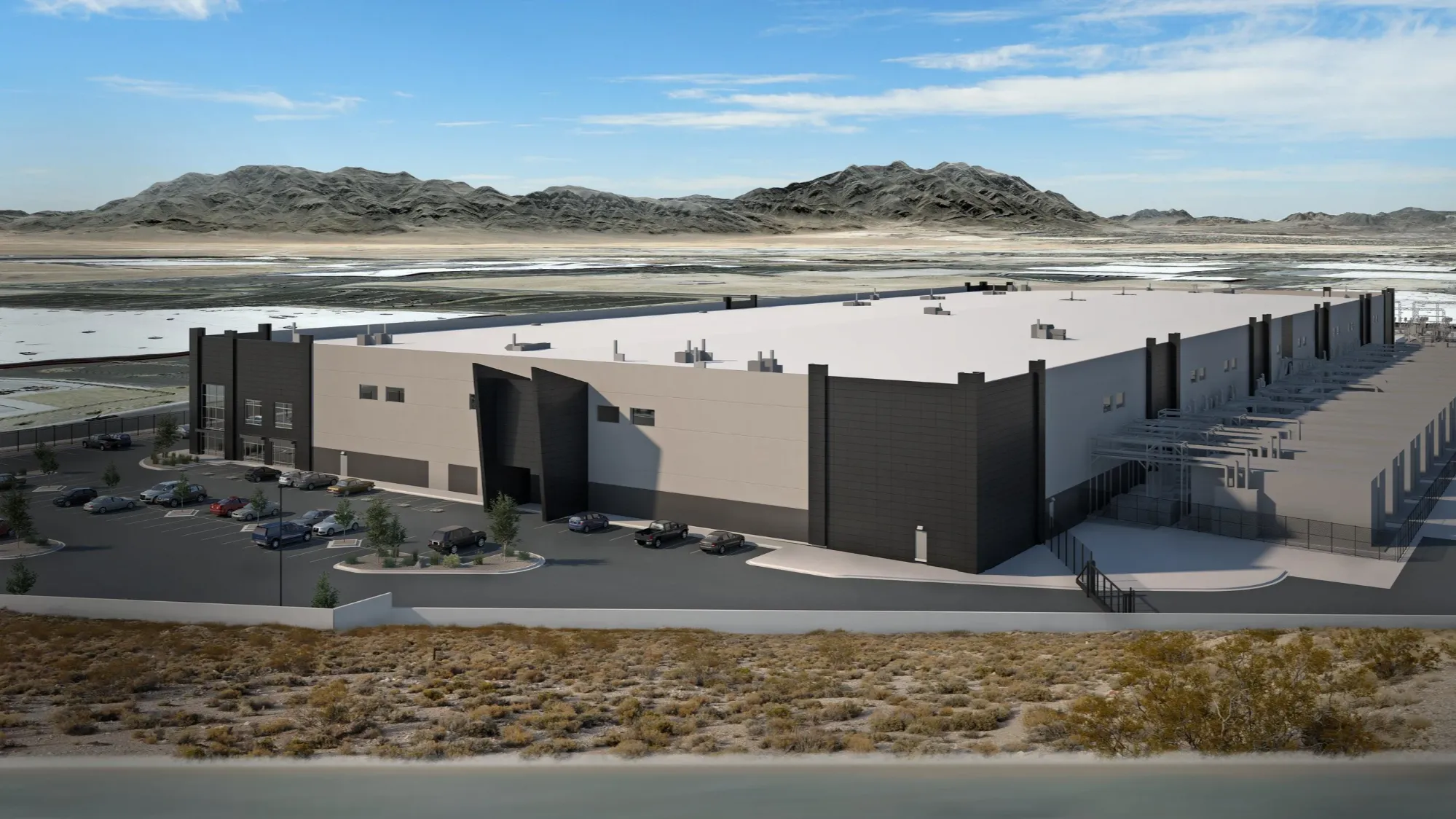
Caption: Renderings and proposed projects matter because the real estate question is not just what exists today, but what may be approved around a property tomorrow.
Why buyers should care about what could come next
One approved data center does not always stay one data center.
Once land is entitled, utilities are planned, and supporting infrastructure is in place, other similar projects can become easier to approve nearby. That is one reason some markets end up with clusters rather than isolated facilities.
For a homebuyer, that changes the due-diligence conversation.
The right question is not only:
Is there a data center near this home today?
It is also:
What has been approved, what is proposed, what does the zoning allow, and what could this area look like five years from now?
That is where real estate advice becomes useful.
What should a Las Vegas or Henderson buyer investigate?
If I were helping a buyer evaluate a property near future development land, I would want answers to these questions:
- What is the current zoning on nearby land?
- Are there pending applications for industrial, utility, or infrastructure uses?
- Is there planned power infrastructure such as substations or transmission improvements nearby?
- What kind of cooling and building systems are proposed?
- Will there be generator noise, lighting, truck traffic, or other operational impacts?
- Is this likely to remain a single project, or could it become a larger cluster?
- How will the surrounding area feel to a future buyer at resale?
This is why I always tell clients that a listing only tells part of the story.
A listing tells you about the house. Due diligence tells you what you’re buying around it.
Final thoughts
Data centers are not automatically bad for housing.
They are also not something buyers should casually dismiss.
The best available research offers some reassurance. Home values near large data centers have generally moved in line with comparable neighborhoods, at least in the early years studied. But the next wave of development is larger, more power-intensive, and moving into new kinds of communities.
For Las Vegas and Henderson buyers, the smarter approach is not fear. It is clarity.
If you are considering a home near major future development land, industrial zoning, or expanding infrastructure, the question is not just whether the home works for you today. It is whether the surrounding environment will still make sense for your lifestyle and resale plans later.
That is the work that matters.
Frequently Asked Questions
Do data centers lower nearby home values?
Not based on the best current research. So far, home prices near newly opened large data centers have generally moved in line with comparable neighborhoods without them.
Are data centers expanding in Las Vegas and Henderson?
Yes. Southern Nevada is part of the broader expansion story, which is why local governments, utilities, and buyers are paying closer attention to where these projects are located and how they are evaluated.
Should homeowners expect lower property taxes near a data center?
No. There is no clear evidence that a new data center automatically lowers nearby homeowners’ property-tax bills.
Why are data centers controversial?
The biggest concerns usually involve electricity demand, water use, cooling systems, noise, traffic, infrastructure strain, and the long-term effect of industrial development near homes.
What should buyers ask before purchasing near one?
Ask about zoning, pending development applications, utility infrastructure, cooling systems, noise, visibility, traffic, and the long-term development pattern of the area.
Need help evaluating the area around a home?
If you are buying in Henderson or the Las Vegas Valley, I can help you look past the listing photos and evaluate the surrounding land use, future development, and resale implications before you commit.
Categories
Recent Posts