
Why Are So Many Homes Having Flooring Problems?
What buyers, homeowners and remodelers should know about laminate and floating plank flooring
I've reached the point where I no longer consider flooring problems unusual.
This is also changing how I represent home buyers
At least six of my clients have experienced problems with laminate or floating plank flooring in the last year. These weren't older homes or inexpensive remodels. I've seen problems with brand-new construction from major builders, resale homes and recently remodeled properties.
The pattern is surprisingly similar. The floor looks perfectly acceptable at first. Then planks begin lifting, separating, making noise or flexing when someone walks across them.
That raises two questions:
Why is this happening?
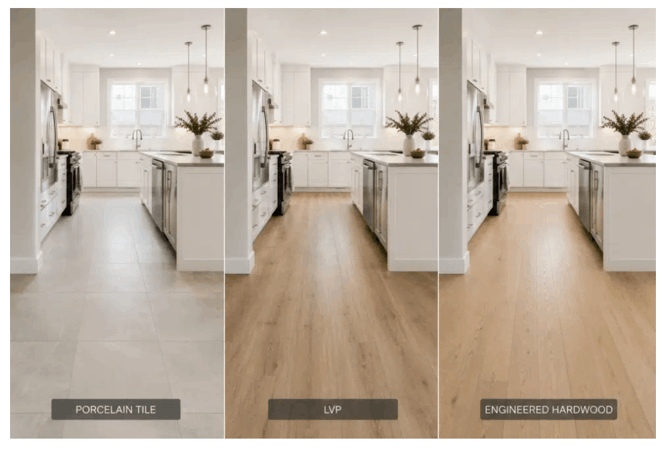
And why are floating plank floors being installed in so many homes instead of traditional ceramic or porcelain tile?
Why floating floors became so popular
There is nothing inherently wrong with laminate or luxury vinyl plank flooring. Good-quality products installed correctly can look attractive and perform very well.
But there are practical reasons builders and remodelers like them.
They are generally less expensive to install than tile.
Traditional tile requires substantial preparation, layout, cutting, mortar, individual placement, grouting and cleanup.
Many laminate and LVP products use a click-lock system that floats over the properly prepared surface beneath it. That generally requires fewer labor hours and can be installed considerably faster.
For a large builder, speed matters almost as much as material cost. Shaving time off flooring installation across hundreds of homes can represent a substantial savings.
For homeowners remodeling a house, the appeal is similar. You can get the appearance of wood without installing hardwood and often for considerably less than a quality tile installation.
The tradeoff is that floating floors are very dependent on proper preparation and installation.
A shortcut underneath the floor may not be visible when the job is completed. You may discover it months later.
First, laminate and LVP aren't the same thing
Homeowners frequently use the terms laminate, vinyl plank and LVP interchangeably.
They are different products.
Traditional laminate commonly contains a fiberboard-based core. Luxury vinyl plank uses a vinyl or composite construction. Their resistance to water and moisture can therefore be quite different.
What many of them share is the floating click-lock installation method.
That means the finished floor isn't normally nailed permanently to the concrete slab. It needs to be installed according to the manufacturer's specifications and allowed to move as designed.
When that doesn't happen, trouble begins.
Warning signs I wouldn't ignore
Walk through the home slowly and pay attention to what you see, hear and feel.
Watch for:
- Planks rising where two pieces meet
• Areas lifting near walls, cabinets or doorways
• Gaps developing between boards
• Edges that appear swollen or raised
• Flooring that moves or flexes underfoot
• Hollow or clicking sounds
• Planks that keep separating
• Problems around refrigerators, dishwashers, sinks and exterior doors
One of the easiest checks costs nothing.
Walk the home in socks.
A floor that noticeably moves, clicks or feels hollow deserves a closer look.
What commonly goes wrong
Some flooring failures aren't really flooring problems. They're installation problems.
An independent flooring inspector may look for:
Insufficient expansion space
Floating flooring generally needs room around the perimeter to move. The required clearance depends on the flooring manufacturer.
Flooring that has been pinned
Cabinetry, islands, trim, fasteners or other construction details can sometimes prevent a floating floor from moving as intended.
An uneven slab
A plank floor can bridge small low areas in the concrete. Over time, repeated movement can stress the locking system and create clicking, movement or separated joints.
Moisture problems
Concrete can transmit moisture even when the surface appears dry. Depending on the flooring system and manufacturer's requirements, moisture testing and an appropriate vapor-control system may be necessary.
Improper acclimation or site conditions
Some flooring manufacturers require specific temperature, humidity or acclimation conditions before installation.
Poorly connected locking joints
If the locking system isn't completely engaged, movement and separation can develop later.
The important point is that the manufacturer's instructions matter.
There isn't one universal expansion gap, moisture level or installation method that applies to every product.
Why Las Vegas deserves special attention
Our climate adds another variable.
Las Vegas is extremely dry for much of the year, while indoor temperature and humidity can change significantly when a home sits vacant.
Think about a vacant new construction home during summer.
It may sit relatively warm during portions of construction and then suddenly be continuously air-conditioned once someone moves in.
Second homes can experience the same thing.
We also have extensive use of concrete slab construction. That makes slab flatness, moisture conditions and proper installation procedures especially important when installing floating flooring.
None of this means Las Vegas is somehow unsuitable for laminate or LVP.
It means the installation needs to respect both the product and the conditions of the property.
Buying new construction
Don't assume a new home automatically means a properly installed floor.
During your walkthrough, pay attention to:
- Movement or clicking underfoot
• Raised joints
• Separating planks
• Flooring tight against walls or cabinetry
• Uneven areas
• Changes that develop during the first several months
Document concerns with photographs and report them to the builder in writing.
And read your actual warranty.
Coverage varies by builder, and the homeowner may also have responsibilities involving maintenance, temperature and humidity.
For significant flooring concerns, I would rather have an independent flooring inspector determine the cause than spend months watching the flooring manufacturer, installer and builder point fingers at one another.
Buying a resale home
A normal home inspection remains extremely important, but a flooring inspector performs a different function.
A home inspector may correctly identify that a floor is lifting.
A flooring specialist may be able to determine why.
That's important because the repair for an uneven slab may be very different from the repair for moisture intrusion, insufficient expansion clearance or a damaged locking system.
If I saw obvious movement or buckling during a resale inspection, I would want to understand the cause before the buyer's due-diligence period expired.
Remodeling your home
This is where homeowners have the most control.
Before installation, ask:
- What exact flooring product is being installed?
- What does the manufacturer require for slab preparation?
- Will the slab be checked for flatness?
- Is moisture testing required?
- What underlayment or vapor protection does the manufacturer specify?
- Does the flooring require acclimation?
- What expansion spacing is required?
- Are transitions required for long continuous runs?
And keep the product information.
Save a box label and several extra planks.
Trying to identify an exact flooring product five years later can be surprisingly difficult.
When should you call an independent flooring inspector?
If the floor is substantially lifting, separating, flexing or showing unusual moisture-related damage, I would consider getting an independent flooring inspection before authorizing major repairs.
Ideally, that person doesn't sell flooring and isn't bidding on the repair.
You're paying them to answer one question:
What actually caused the failure?
A useful inspection may include moisture readings, floor-flatness measurements, temperature and humidity readings, photographs, examination of expansion areas and comparison with the flooring manufacturer's installation specifications.
That report gives you something more useful than competing opinions from the people potentially responsible for the floor.
This is also changing how I represent buyers
After seeing too many clients discover flooring problems after closing, I've changed my own approach.
As a buyer's representative, I no longer want to wait for the phone call months later saying, “Roger, something is wrong with the floor.”
Over the past several years, laminate, LVP and other floating plank flooring systems have become extremely common in both new construction and resale homes. My experience has also shown me that installation problems are common enough that I don't think buyers should simply assume the floor is fine because it looks good during a showing.
When a home has this type of flooring, I will recommend considering a separate, independent flooring inspection early in the due-diligence period.
The purpose is not to go looking for problems where none exist. It is to confirm, as much as reasonably possible, that the flooring has been properly installed and that there are no conditions likely to create problems down the road.
That inspection is separate from the general home inspection.
I'd much rather help a client confirm the floor is performing as it should before closing than wait for a lifting, separating or flexing floor to become a problem months later.
That is part of how I view buyer representation.
My job isn't simply to find a property and write an offer. It is to recognize areas where experience tells me a closer look may be worthwhile, bring in the right specialist when appropriate, and help my clients reduce the number of unpleasant surprises after they own the home.
What if the builder or contractor won't correct it?
For new construction, start with the builder's written warranty procedure.
Nevada also has specific laws governing construction defects, including notice, inspection and an opportunity to repair. Significant disputes may eventually involve Nevada's construction-defect procedures under NRS Chapter 40.
For remodeling work, verify the contractor through the Nevada State Contractors Board. Nevada generally requires contractor licensing once a project reaches the applicable licensing threshold, subject to limited exceptions.
Eligible Nevada homeowners who suffer qualifying losses caused by properly licensed residential contractors may also have access to the state's Residential Recovery Fund.
These situations become fact-specific quickly, so significant disputes should be discussed with the appropriate Nevada construction professional or attorney.
One final thought
I'm not telling people to stop buying homes with laminate or luxury vinyl flooring.
I'm saying we should stop looking only at the surface.
A beautiful floor tells you very little about what happened underneath it.
I've now watched enough clients deal with flooring problems that this has changed the way I represent buyers. When appropriate, I will recommend an independent flooring inspection during due diligence instead of waiting to discover the problem after closing.
That is exactly when a buyer should be asking questions, while there is still time to get answers.
Good buyer representation isn't just opening doors and negotiating price.
It is knowing what deserves a closer look, knowing when a specialist should be brought in and helping a client make a better-informed decision before the property becomes theirs.
If you're considering buying a home in the Las Vegas Valley, especially one with laminate, LVP or another floating plank flooring system, I'm happy to explain the inspection process I now recommend to my buyers.
Roger Price Owens, LLC
REALTOR® | Real Broker, LLC
702-985-6625
roger@roger.realtor
www.listingsoflasvegas.com
Nevada License S.0179116.LLC
This article is provided for general consumer information and is not legal, engineering or construction advice. Product requirements, warranties and Nevada laws should be verified for the specific property and circumstances involved.
Categories
Recent Posts